
Choosing the Best Journals for Bullet Journal Success in 2026
The difference between a cluttered mind and a streamlined life isn't your willpower; it's the paper engineering beneath your pen. While many view a notebook as a simple stack of paper, enthusiasts know that the best journals for bullet journal success function as a curated interface between thought and action. You’ve likely felt the frustration of a beautiful layout ruined by ink bleeding through the page or a spine that refuses to lie flat while you work. It’s difficult to maintain a daily habit when your tools feel like an obstacle rather than an invitation.
We're here to help you find a reliable daily organization tool that honors your craftsmanship and personal style. You'll discover how to select the perfect paper and binding to transform your analog organization into a seamless creative experience. This guide demystifies technical terms like GSM versus paper coating and explores the 2026 collections from heritage makers like Leuchtturm1917 and Dingbats*. From finding a truly fountain pen friendly notebook to understanding why 160gsm has become the new standard for collectors, we'll ensure your next journal is a masterpiece of both form and function.
Key Takeaways
- Learn why the "Analog Escape" provides a superior cognitive experience compared to digital apps in 2026.
- Decode technical paper specifications like GSM and texture to ensure your favorite fountain pens glide without bleeding or ghosting.
- Categorize the best journals for bullet journal use by your specific style, from modular Traveler’s Notebooks to high-GSM artistic canvases.
- Follow a professional step-by-step guide to prepping your physical notebook for a year of organization, including a custom productivity key.
- Understand the value of sourcing heritage brands from authorized boutique retailers to guarantee authentic material quality and craftsmanship.
Understanding the Anatomy of Premium Journals for Bullet Journal Use
In 2026, the "Analog Escape" represents a conscious decision to trade digital fatigue for tactile clarity. Selecting the right journals for bullet journal use involves more than picking a pretty cover; it requires an understanding of how physical materials interact with your specific writing style. The Bullet Journal system demands a notebook that can survive being opened dozens of times a day while maintaining its structural integrity. It isn't just a place to store lists. It’s a specialized vessel designed to hold your time and focus.
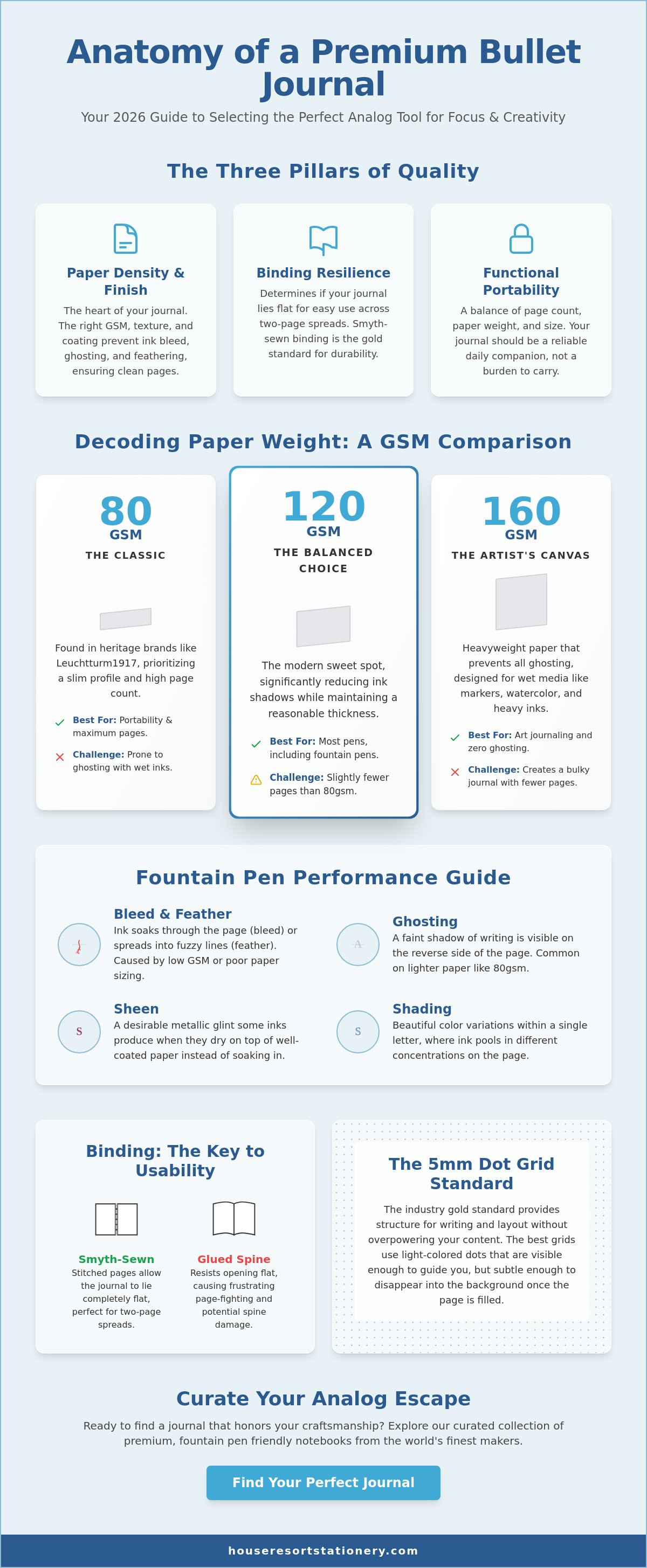
Quality is built on three essential pillars: paper density, binding resilience, and functional portability. When evaluating journals for bullet journal success, ghosting is often the first obstacle you'll face. This distracting shadow occurs when ink is visible on the reverse side of a page, creating a messy visual noise that disrupts your layout. Premium manufacturers solve this through superior fiber engineering and specialized surface treatments that manage ink absorption before it penetrates the page. A truly professional journal feels like a tool, not a toy.
The Dot Grid: Why 5mm is the Gold Standard
The 5mm dot grid is the industry standard for a reason. It provides enough structure to keep your columns straight while remaining subtle enough for creative sketching. Spacing matters because it dictates your handwriting size and how much data you can fit on a single spread. Pay close attention to dot opacity. The best makers ensure dots are visible enough to guide a ruler but light enough to disappear once you fill the page with content. This balance prevents the grid from clashing with your headers or elaborate task lists.
Lay-Flat Binding: The Secret to Usable Spreads
A journal that fights to close while you write is a failure in design. Look for Smyth-sewn binding, where folded groups of pages are stitched together rather than just glued. This method is vastly superior to mass-market glued spines because it allows the book to lie completely flat. This flat surface is vital for technical layouts and long writing sessions. To properly break in a new spine, place the journal on a flat surface and open the front and back covers. Alternate pressing down a few pages at a time toward the center. This technique ensures the binding remains flexible and durable for the life of the notebook.
Key Paper Features: GSM, Texture, and Fountain Pen Compatibility
Paper weight is the most misunderstood specification in the stationery world. GSM, or Grams per Square Meter, measures the density of the paper, but it isn't always a direct indicator of quality. When selecting journals for bullet journal use, you'll typically choose between three tiers. The classic 80gsm paper, found in heritage brands like Leuchtturm1917, offers a high page count and a slim profile. It's the choice for those who prioritize portability. In contrast, 120gsm paper provides a balanced middle ground, significantly reducing ink shadows. The 160gsm "heavyweight" options are essentially cardstock, designed for artists who use wet media or heavy markers. While 160gsm prevents all ghosting, it often results in a bulkier book with fewer pages.
Texture, or "tooth," describes the physical feel of the page. Smooth paper allows a pen to glide effortlessly, which is ideal for fast note-taking. Textured paper provides a slight resistance that gives you more control over your strokes. This tactile feedback is essential for those who find smooth surfaces too slippery for precise layouts. Beyond weight and texture, professional-grade paper features "sizing." This is a chemical coating that prevents ink from soaking into the fibers too quickly. Without proper sizing, even thick paper can suffer from feathering, where ink spreads out in tiny branches. For those seeking a deeper dive into maker-specific performance, this comprehensive review of the best bullet journals offers a side-by-side comparison of how these weights perform under pressure.
Fountain Pen Friendly Paper: Beyond the Bleed
True connoisseurs look for paper that showcases "sheen" and "shading." Sheen is the metallic glint some inks produce when they dry on top of the paper rather than soaking in. Shading refers to the beautiful color variations within a single letter. Heritage brands like Midori MD use unique pulp blends that feel almost organic under a nib. You can explore these specialized materials in our Japanese Stationery Online Store Guide, which highlights tools that pair perfectly with unique paper stocks.
Ghosting vs. Bleeding: Know the Difference
Ghosting is the faint shadow of writing seen on the reverse side of a page. Many minimalists actually enjoy this "used" aesthetic, as it gives the journal a lived-in feel. Bleeding is different; it's when ink physically saturates the paper and spots the next page. This is a dealbreaker for any journals for bullet journal setup. We always recommend dedicated "Pen Test" pages at the back of your book. Testing your favorite tools there ensures your main spreads remain pristine. If you're ready to upgrade your setup, we invite you to explore our collection at HouseResort Stationery.
Comparing Top-Tier Brands for Different Journaling Styles
Finding the ideal journals for bullet journal setups depends entirely on how you interact with the page. A professional who needs a modular system for work will have vastly different requirements than an artist who uses their notebook as a daily canvas. The architecture of the book should mirror your workflow. For instance, the Traveler’s Notebook offers a modular solution where you can swap inserts for specific projects or years. This flexibility is rare in traditional bound books. It suits those who value a long-term leather companion that evolves over time.
Cover choice is another critical factor in daily usability. Hardback journals provide a rigid writing surface. This is essential if you often journal on trains or away from a desk. They protect the corners of your pages from bending over months of heavy use. Softback versions are preferred by those who value a lighter carry and want a book that feels less formal. You also need to balance page count with portability. A notebook with 250 pages might last an entire year, but it'll be significantly heavier than a 160-page alternative. Understanding these trade-offs is key to maintaining your habit without physical strain.
Technical specifications like feathering and bleed-through are paramount when choosing a brand. This guide to fountain pen-friendly paper provides a deep dive into how various manufacturers handle wet inks. This technical precision is why certain journals for bullet journal use become favorites among collectors who move beyond standard ballpoints.
The Minimalist Choice: Focus on Efficiency
The minimalist prioritizes speed and organization. Brands like Leuchtturm1917 remain a top choice here, particularly with their "Bullet Journal Edition 2" which features 120gsm paper and pre-numbered pages. These notebooks include a built-in index and dedicated future log spreads. By removing the need to manually number every page, they allow you to focus purely on your tasks. Their paper is light enough to keep the book slim while remaining resilient enough for most professional inks. It’s the perfect balance for the on-the-go organizer.
The Artistic Choice: A Canvas for Creativity
If your journal is filled with watercolors, gouache, or heavy markers, you need 160gsm paper. This weight acts more like cardstock, preventing any chance of ink soaking through. Pay attention to the paper tone. "Bright white" pages make ink colors pop with high accuracy, while "cream" pages offer a warmer aesthetic that's easier on the eyes during long writing sessions. To pair your artistic layouts with the right tools, consult our guide on The Best Fountain Pen for Planner Decoration to ensure your nib matches your paper’s potential.
How to Set Up and Test Your New Bullet Journal
Setting up a new journal is a ritual. It’s the bridge between your past year’s data and your future intentions. When you unwrap high-end journals for bullet journal use, the temptation is to start writing immediately. Resist this. Begin by preparing the physical object. Open the covers and gently press down the pages to encourage the lay-flat binding to settle. This initial care prevents the spine from cracking later. Next, define your "Key." While the standard system uses dots for tasks and circles for events, your symbols should reflect your specific 2026 productivity needs. Perhaps a triangle for meetings or a star for deep-work blocks.
Migration is the most critical phase of the setup. It isn't just copying lists. It's a filter. Look at every unfinished task in your old notebook. Ask if it still matters. If not, discard it. This process keeps your new journal lean and relevant. Don't fear the first page. Perfectionism is the enemy of a consistent habit. If you make a mistake, simply turn the page. The value of journals for bullet journal success is in their utility, not their aesthetic perfection. A used, slightly messy notebook is a sign of a life being lived.
The Essential Pen Test Page
The back pages of your journal are your laboratory. Before committing to a layout, test every tool in your collection. Write the name of the pen and the ink brand, then wait thirty seconds. Check for dry times to avoid smearing. Look closely at the edges of the ink for feathering. This is also the time to test highlighters and markers. Some high-GSM papers repel certain water-based markers, while others absorb them too quickly. Knowing how your paper reacts saves you from ruined spreads later.
Indexing and Threading: Navigating Your Thoughts
Navigation is what separates a journal from a simple diary. If your notebook lacks a pre-printed index, reserve the first four pages. List your collections and their page numbers as you create them. Use "threading" to link related content. If a project starts on page 10 and continues on page 45, write "10/45" at the bottom of the page. You can also use fountain pen doodle journaling for beginners techniques to create visual edge-markers for different months or categories. This allows you to find information in seconds without flipping through every page.
Ready to begin your next chapter? EXPLORE our curated selection of professional tools at HouseResort Stationery.
Curating Your Analog Escape with HouseResort Stationery
HouseResort functions as more than a simple retailer; it's a boutique gallery for the analog enthusiast. We understand that the search for the best journals for bullet journal success is often a search for a reliable partner in your daily life. By acting as an authorized retailer for heritage brands, we guarantee that every notebook in our catalog meets the rigorous standards of paper engineering we've discussed. You won't find mass-market substitutes here. Instead, you'll find tools that respect the nib of your fountain pen and the weight of your thoughts. Authenticity matters when your legacy is on the line.
The tactile joy of this hobby comes from the perfect marriage of ink and fiber. There's a specific satisfaction in watching a wet ink dry slowly on a sized page, or feeling the sturdy resistance of a Smyth-sewn binding as it yields to your touch. We've done the heavy lifting of filtering the market to present only the most resilient and inspiring options. This curation ensures your focus remains on your organization rather than struggling with substandard materials. Our 2026 collection reflects a deep appreciation for the makers who still prioritize craftsmanship in an increasingly digital world.
The Connoisseur’s Edge: Why Materials Matter
Quality tools do more than look professional; they actively reduce the friction of starting and maintaining a new habit. If you enjoy the feel of your pen on the page, you're significantly more likely to open your journal every morning. We prioritize acid-free paper across our inventory to ensure your archives remain pristine for decades. These materials don't yellow or become brittle, which is vital for long-term reflection. When choosing your next companion, consider a cover color that resonates with your personal energy. A vibrant yellow might spark morning creativity, while a deep forest green offers a sense of calm for evening reflection.
Join the HouseResort Community
We're committed to helping you find your "forever" journal. Our team views every transaction as a shared passion for quality materials. If you're unsure which paper weight pairs best with your specific ink collection, we encourage you to explore our video series for curated recommendations and nib pairings. These resources humanize the digital shopping experience and provide the expert guidance you'd expect from a specialized boutique. We believe your journals for bullet journal use should be a relaxing escape, not a chore.
Ready to transform your productivity? Explore our curated selection of fine journals and notebooks and discover the difference that professional-grade materials make in your daily routine.
Elevate Your Daily Routine with Purposeful Tools
The journey toward a more organized life begins with a single, intentional stroke on the right page. You've learned how technical specifications like GSM and sizing dictate how your ink behaves. Selecting the right journals for bullet journal use isn't just about utility; it's about finding a tactile companion that encourages your best thinking. Whether you require modular flexibility or the sturdy reliability of a heritage hardback, your choice should reflect your unique creative rhythm.
As an authorized retailer for brands like Lamy, TWSBI, and Midori, we invite you to explore a world where craftsmanship meets productivity. Our curated selection focuses on fountain pen friendly paper and verified durability. If you're still weighing your options, our expert video recommendations offer a closer look at how different nibs interact with our premium stocks. It's about reducing friction and celebrating the art of the handwritten word.
Browse Our Curated 2026 Journal Collection and find the interface that transforms your analog escape into a seamless reality. Your future self will thank you for the clarity.
Frequently Asked Questions
What is the best paper weight (GSM) for bullet journaling?
The ideal paper weight depends on your media, but 120gsm is currently the gold standard for most users in 2026. It provides a significant barrier against ghosting without the excessive bulk of 160gsm cardstock. If you primarily use gel pens or light fountain pen ink, this weight maintains a high page count while ensuring your spreads remain clean on both sides of the sheet.
Can I use a fountain pen in a standard dot grid notebook?
You can use a fountain pen if the notebook features sized, ink-resistant paper. Standard mass-market notebooks often lack the specific coating required to prevent feathering or bleeding. Look for heritage makers like Midori or Leuchtturm1917, who engineer their dot grid pages specifically to handle wet ink. These manufacturers ensure the ink sits on the surface rather than soaking into the fibers.
How do I stop my pens from bleeding through the journal pages?
Preventing ink from bleeding requires matching your pen's flow to the paper's absorption rate. Switching to a notebook with at least 120gsm or 160gsm paper is the most effective solution for wet inks. Additionally, using "dry" inks or fine-gauge nibs reduces the volume of liquid hitting the page. Always perform a pen test on the final pages to verify compatibility before starting a new layout.
What is the difference between a planner and a bullet journal?
A planner contains pre-printed dates and layouts, while a bullet journal is a modular system built in a blank or dot grid notebook. Planners offer immediate structure but lack flexibility. In contrast, the best journals for bullet journal use allow you to design custom collections, trackers, and logs that evolve with your specific needs. This adaptability is the core strength of the analog journaling method.
Should I choose a hardback or softback journal for daily use?
Choose a hardback journal if you require a rigid writing surface for journaling on the go. Hard covers protect page corners from wear during daily transit and provide stability when a desk isn't available. Softback journals are superior for those prioritizing a lightweight, flexible book that fits easily into slim bags. Your choice should align with your typical writing environment and portability requirements.
How many pages do I need for a full year of bullet journaling?
Most enthusiasts find that 160 to 250 pages are sufficient for a full year of organization. A minimalist setup with simple daily logs typically fits into a slimmer 160-page book. If you include elaborate weekly spreads, habit trackers, and long-form journaling, you'll likely need a higher page count. Balancing this count with the physical weight of the notebook is essential for daily comfort and carry.
Is white or cream paper better for color ink journaling?
Bright white paper is superior for color accuracy and making vibrant inks pop. It provides a neutral base that doesn't shift the hue of your markers or fountain pen inks. Cream paper is often preferred for long writing sessions because it reduces glare and eye strain. If your priority is artistic decoration and color-coding, white pages offer the most professional results for your 2026 layouts.
Do I need a special notebook to start the Bullet Journal Method?
No specific brand is required to start, but certain features significantly enhance the experience. While any dot grid notebook works, premium journals for bullet journal setups often include pre-numbered pages and built-in indexes. These technical additions save time and reduce the friction of the initial setup. Starting with quality materials ensures your focus remains on productivity rather than struggling with poor paper performance.